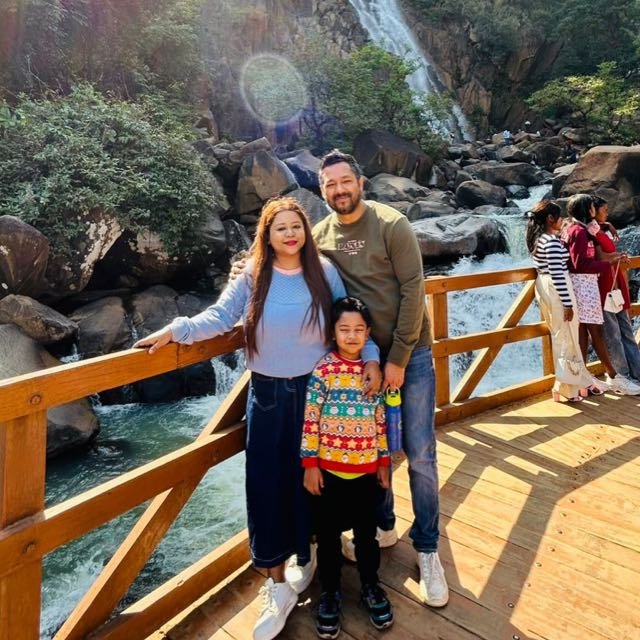
When Kiran was diagnosed with autism, it felt like the ground had shifted beneath my feet. As a software engineer, I was used to solving problems with logic and precision—but this was different. There was no step-by-step guide, no code to debug, no clear roadmap. My wife and I were flooded with uncertainty, questions, and fears about what the future held for our son.
At first, I struggled to understand Kiran’s world. He had always been different, not in a way that worried us initially, but in a way that made him uniquely him. He rarely made eye contact, preferred lining up his toys instead of playing with them, and found comfort in routines that never wavered. But there was one thing that always lit up his face—space.
From the moment he saw a picture of Saturn in a book, he was mesmerized. The rings, the colors, the sheer vastness of the universe—it became his obsession. He would sit for hours watching documentaries about black holes and galaxies, rattling off facts about nebulae that even I had to Google to verify.
Kiran didn’t speak much, but when he did, it was about the stars.
One evening, after a particularly tough day at therapy, I found him sitting by the window, staring at the night sky. I sat beside him, unsure of what to say. Then, in his small, determined voice, he asked, “Papa, do you think I can touch the stars?”
I blinked back tears. In that moment, I realized that while I had been so worried about his challenges, Kiran had been dreaming of something much bigger.
That night, I made a promise—to stop seeing limitations and start focusing on possibilities.
Small Steps, Big Wins
Our first real milestone came when Kiran spoke in full sentences for the first time. It wasn’t during a therapy session, nor was it a rehearsed script. We were watching a space documentary when he turned to me, eyes shining, and said, “Papa, Jupiter has 79 moons! I wish I could visit them all.”
It was as if the universe had aligned at that moment. Kiran’s voice, filled with excitement, was the most beautiful sound I had ever heard. It didn’t matter that it had taken years to get here—it was his journey, and he was making progress at his own pace.
From then on, we found ways to integrate his love for space into everyday learning. Counting the planets helped with numbers, memorizing constellations helped with speech, and watching rocket launches together became our bonding time. When he struggled with emotions, we talked about how even stars have lifecycles—how they burn bright, fade, and sometimes transform into something new.
Each step forward—whether it was trying a new food, making a friend at school, or expressing his feelings—became a moment to celebrate. Kiran taught me that progress isn’t always linear, and milestones aren’t measured in comparison to others. They are the moments when he shines in his own way, at his own time.
A Universe of Possibilities
Inspired by our journey, I started a blog to share our experiences. I wanted other parents to know they weren’t alone—that their child’s differences weren’t obstacles but unique ways of seeing the world. The response was overwhelming. Parents reached out, sharing their own struggles and victories. We built a small, supportive community, all connected by the same hope: that our children would be understood, accepted, and celebrated.
A few months ago, we took Kiran to a planetarium for the first time. As we sat in the dark, watching the vast universe unfold above us, he reached for my hand and whispered, “It’s beautiful, Papa.”
And in that moment, I knew—Kiran was touching the stars.
Not in the way he once imagined, but in a way that was just as extraordinary.
Because for him, every new word, every new step, every moment of connection—was a star shining brightly in his own universe. And I? I was the luckiest father in the galaxy, just along for the ride.