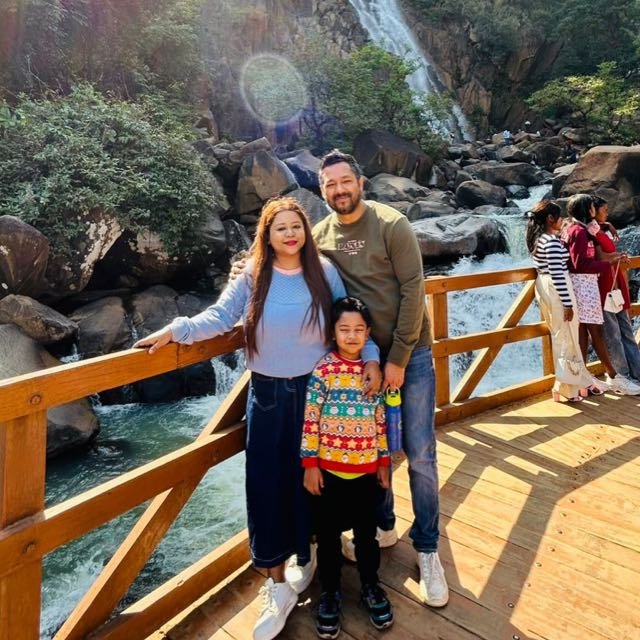
When Aarya was diagnosed with autism, I found myself overwhelmed with questions and uncertainties. How would I balance my growing business with his needs? Would he ever truly connect with the world around him? But in those moments of doubt, his older sister, Anika, stepped in—not just as a sibling, but as his fiercest advocate, his patient teacher, and his best friend.
Anika was 13 when we received Aarya’s diagnosis. She had always been protective of him, but something shifted that day. I remember her sitting beside me after the doctor’s visit, holding my hand, and saying, “Mom, Aarya is still Aarya. We just need to understand him better.” Her words, simple yet profound, became our guiding light.
From an early age, Aarya’s love for numbers was undeniable. While other kids played with toys, he arranged numbers in sequences or recited multiplication tables effortlessly. Math was his comfort, his language. And Anika, despite struggling with math herself, saw this as an opportunity to bond with him in a way that was uniquely theirs.
I would often find them sitting together, Anika with her homework spread out, Aarya peering over her shoulder, his fingers tracing the equations. “Aarya, can you help me with this?” she would ask, and his face would light up. Numbers made sense to him in ways they never did for her, and in that moment, their roles reversed—Anika became the student, and Aarya, the teacher.
But their relationship wasn’t always easy. There were days when Aarya struggled with sensory overload, his emotions spilling out in ways Anika didn’t always understand. Once, during a family gathering, the noise and chaos overwhelmed him, and he retreated to a corner, covering his ears. Some relatives exchanged awkward glances, whispering words that stung. Anika, seeing this, stood tall and said, “He just needs some quiet. That’s all. Not everyone likes loud music and crowds.” Her confidence silenced the murmurs, and in that moment, I saw the depth of her love.
As Aarya grew, so did their bond. When I founded my social enterprise to employ neurodiverse individuals, Anika was my biggest supporter. She saw firsthand how talented her brother was, and she wanted the world to see it too. One day, she came to me with an idea. “Mom, what if we create a space where people like Aarya can teach math to kids who struggle with it?”
Her suggestion sparked something in me. Today, our enterprise not only provides employment for neurodiverse individuals but also offers math mentorship programs, where individuals like Aarya can share their gift with others. Anika volunteers every weekend, ensuring that her brother and those like him are valued for their strengths.
Looking back, I realize that while I worried about balancing work and Aarya’s needs, Anika had already taken on the role of his biggest champion. She taught me that acceptance isn’t just about understanding autism—it’s about embracing it, celebrating it, and seeing the extraordinary in the ordinary.
Aarya may count numbers, but I count my blessings—two of them, to be precise. And together, we keep adding moments of love, patience, and triumph to our journey.