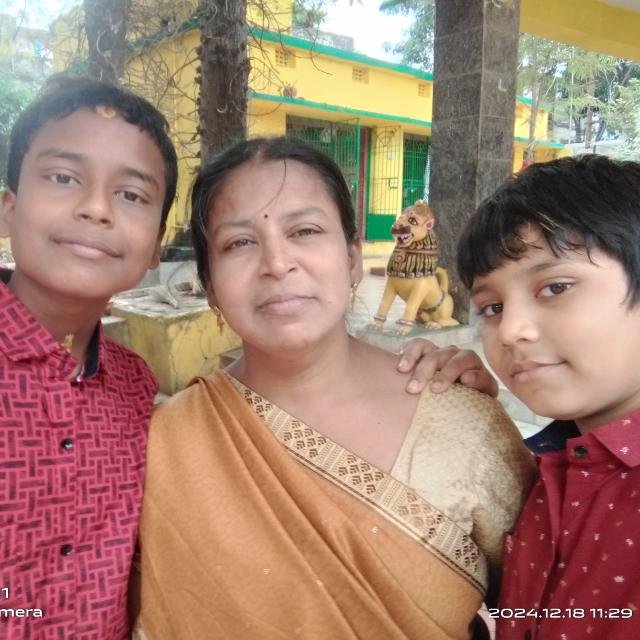
When I retired as a librarian after decades of cataloging books and guiding young minds, I thought my days of learning were behind me. But life had other plans. My greatest teacher arrived in the form of my grandson, Ishaan.
Ishaan, with his bright eyes and love for numbers, entered my life like a puzzle I didn’t yet know how to solve. He could recall long strings of numbers effortlessly, solve equations meant for older children, and find patterns in the most unexpected places. But he struggled with eye contact, preferred solitude over family gatherings, and spoke only when necessary. At first, I thought he was simply different—a quiet, gifted child who preferred numbers over words.
Then came the word that changed everything: autism.
When my daughter and son-in-law told me about Ishaan’s diagnosis, I was bewildered. I had never heard of autism before. In my generation, children who behaved differently were misunderstood, even dismissed. I remember nodding, pretending to understand, but deep inside, I was lost.
I turned to what I knew best—books. I spent hours reading about autism, trying to understand how Ishaan saw the world. I learned that his avoidance of hugs didn’t mean he didn’t love me. That his silence wasn’t a lack of emotions but a different way of expressing them. That his obsession with numbers was not just a quirk but a gift.
I decided that if I, an 80-year-old grandmother, could unlearn old notions and embrace new knowledge, so could others.
Becoming a Voice in My Community
In Varanasi, where traditions run deep, autism is still a mystery to many. I saw families struggling, unsure of how to support their children. I saw mothers battling guilt and fathers seeking answers in prayers instead of awareness. I saw grandparents, like me, standing on the sidelines, confused and helpless.
I couldn’t remain silent.
I started small—conversations in my neighborhood, sharing Ishaan’s story during chai breaks. Slowly, those conversations turned into community sessions. I reached out to local temples, schools, and women’s groups, asking them to lend me their space and time. I explained autism in simple words, breaking myths one by one.
“No, autism is not caused by bad parenting.”
“No, the child does not need ‘fixing.’”
“No, it is not something to be ashamed of.”
I shared how Ishaan’s love for numbers wasn’t a meaningless fixation, but a beautiful strength. I told them about the joy I felt when he counted the temple bells perfectly each evening or how he corrected me when I miscounted money at the market. I explained that children like Ishaan may not always communicate in words, but they express love in their own way—through presence, through routine, through trust.
A Community Transformed
At first, people listened with skepticism. But soon, I saw a shift. Parents who once whispered about their “unusual” children began speaking openly. A grandmother who had been embarrassed by her autistic grandson approached me, tears in her eyes, asking how she could help him thrive. Teachers who thought of neurodiverse students as “difficult” started attending training sessions.
The biggest moment of change came when Ishaan himself became a part of my awareness sessions. One day, as I spoke about his love for numbers, he surprised us all by standing up and reciting the value of Pi up to fifty decimal places. The room, filled with hesitant parents and curious elders, burst into applause. That day, they didn’t see a “child with autism.” They saw a brilliant mind, a unique soul, a boy full of potential.
A Grandmother’s Hope
Today, as I sit beside Ishaan, watching him solve complex equations with ease, I realize that he has given me a new purpose. My journey is not just about him—it is about every child who needs understanding, every family that needs support, and every grandparent who needs to step forward.
Because when the family understands, the child flourishes.
And when a community embraces knowledge, it transforms into a place where children like Ishaan don’t just exist—they shine.